Inbound sales best practice: How to close the gap between marketing and sales
Inbound sales best practice: How to close the gap between marketing and sales

Inbound sales is the new standard in sales. Fundamental changes in the purchasing process make a new approach to selling necessary. Never before have interested parties had such easy access to information and never before has the competitive situation among offering companies been so pronounced. The result: a buyer's market in which cold calling has become expensive and inefficient.
In order for companies to sell successfully despite this, they need to adapt their communication and processes. The concept of inbound sales is to use marketing content to draw the attention of anyone who is interested to your offer and then make the transition from informing and advising to selling. It is precisely at this point that the boundaries between marketing and sales become blurred. But this is also where the biggest challenge of this sales method lies. Many companies still fail to integrate marketing and sales.
This article will help you to identify measures for better cooperation between the two areas. The goal: A full inbound sales pipeline with the right leads that match your ideal image from the target group definition.
What is inbound sales?
Inbound sales follows its own approach to generating leads. Interested parties should approach the company of their own accord in search of information. To this end, the company provides them with content such as e-books, white papers or blog articles. In addition to freely accessible content, there is also content that can only be downloaded if the person leaves their contact details in return - and thus becomes a lead.
In this way, the inbound sales concept works in a fundamentally different way to outbound sales. In this traditional sales method, cold calls or purchased email lists are common strategies for acquiring leads. Successful big names in inbound sales see two major advantages to their approach: firstly, the leads generated through inbound sales are of significantly better quality and secondly, they can achieve better conversion rates through inbound sales. Nevertheless, it cannot be said across the board that outbound sales is bad. Many factors play a role in choosing the right sales strategy: market position and corporate strategy are just two aspects.
What do we expect from inbound sales?
By providing valuable and high-quality content, companies build trust with interested parties. This is an important factor in the purchasing process, as purchasing decisions are not only made on a factual level, but also on a relationship level.
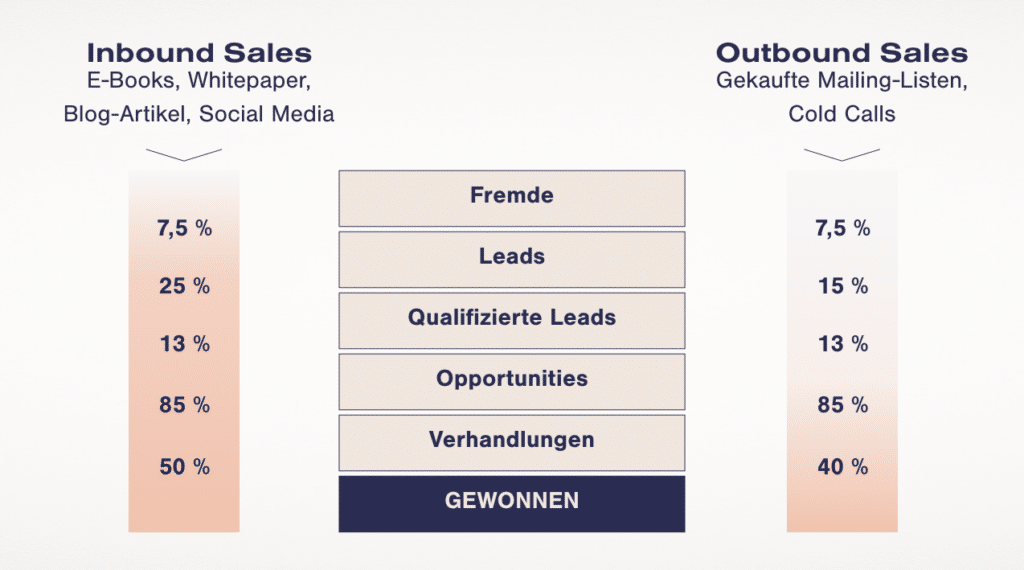
Furthermore, everyone in the inbound sales process can specify when and what information is required from the company. This creates a partially automated dialog between the interested person and the company, in which the company takes on a supporting and advisory role. Knowing what information is needed and when: This is the necessary customer understanding for inbound sales.
Overall, these points result in potentially lower customer acquisition costs as well as more and more attractive deals. In short: the return on investment (ROI) increases. So much for the theory.
Practical comparison: Why do we usually not see these effects?
There are several reasons for this, one of which is the so-called "marketing vs. sales clash". This refers to the different perspectives of marketing and sales with regard to generating customers. Marketing focuses on generating leads, while sales aims to generate revenue. This results in the view in marketing that sales does nothing with the leads generated by its own team. In Sales, on the other hand, the team is of the opinion that Marketing generates bad leads that buy little or generate hardly any profitable sales.
The main reason for these differences is the lack of goal alignment between marketing and sales. The lack of coordination is made clear by processes that are not fully planned. When does marketing hand over a lead to the sales team? Many companies have not clearly defined the answer to this question. At this critical transition of responsibility, leads can get stuck or overlooked. This is fatal, as every single lead represents both acquisition costs and a sales opportunity.
In addition, the marketing and sales departments often have a different understanding of good leads, as approaches for evaluating leads such as lead scoring are not or insufficiently anchored in the process. This also means that the sales team lacks reference points for prioritizing leads. It also becomes problematic if information about a lead that was originally generated by marketing does not reach the sales team.
Why not create the appropriate framework conditions if the problems are known? Another factor plays a role here: the departments often do not have the necessary capacity to coordinate the processes in day-to-day business. This repeats the cycle that leads to inadequate lead generation and lead quality.
A rethink must take place
Rethinking means creating real goal alignment in inbound sales between sales and marketing. To achieve this, marketing must start to think more "downstream" and understand its role as sales enablement. The management of marketing and sales must be end-to-end. This means not only looking at the effects of changes to processes in the department concerned. Instead, those responsible need to keep an eye on the entire sales pipeline.
In summary, this means that successful inbound sales is based on the alignment of marketing and sales objectives. In practice, this means, for example: Incentivizing the marketing team should not depend on MQLs (Marketing Qualified Leads), but on SQLs (Sales Qualified Leads) or turnover.
Levers for better collaboration between sales and marketing in inbound sales
1. alignment of measures to common goals
To define joint measures, you need to answer this question for yourself: Which marketing measures will improve my stage conversions in sales?
Examples of this include the expansion of qualification in marketing. Here, the team must request the details of leads that are really relevant for the sales team. Marketing communication should consist of content that supports the sales process, such as case studies for specific use cases or pain points.
2. joint process development
Here, the sales department must exercise patience with marketing and keep in mind the trade-off between quality and quantity of leads. The motto is: give the marketing team time during the operational set-up of lead generation to find out what works well and where there is still room for improvement. Here, the sales team acts as a source of feedback for marketing. By contacting each lead, the sales team can assess the quality of the leads. This in turn means that marketing and sales often have to coordinate to create tight feedback loops.
On the way to the ideal process, marketing and sales should ask themselves the following questions together:
- Where does the lead come from?
- What information do we need to request?
- What is the history of a lead?
- What does the follow-up process in Sales look like?
- When is the ideal handover point between marketing and sales?
- How can marketing support the follow-up process, e.g. through content or re-marketing?
3. creating a common understanding aka. the path to the ideal customer profile
To characterize the ideal idea of an ideal customer, you use data from marketing, from sales meetings in sales and "postbound" data (actual data of the person). The interaction of these three data sources enables the continuous further development of the Ideal Company Profile (ICP) and the buyer persona.
4. behavior-based lead scoring
Behaviour-based lead scoring supports the systematic prioritization of leads. The method uses parameters that are based on a person's behavior. In this context, behavior is defined by these factors:
- Webpage Visits
- Form submissions
- Downloads
- E-mail behavior
- Social media engagement
Leads do not only collect positive points in this system: Negative scoring occurs when a person exhibits behavior that conflicts with the desired behavior. Lead scoring can also be used to determine where a lead is currently in the customer journey.
5. automation of lead qualification
Categorizing leads into different phases helps with the automated qualification of leads. It starts with "Top of the Funnel", i.e. a person has downloaded something for the first time, read a blog article or taken part in a webinar. This is followed by "Middle of the Funnel". In this phase, the team continues to provide the lead with case studies, free trials or a product demo. The conversion of a lead to another phase takes place through automated if-then conditions.
In short: you only win as a team
A professional skier can't win a race without perfectly prepared skis and we probably don't need to explain what would happen in soccer without a goalkeeper. The same applies to marketing and sales: one cannot do without the other and they can only be successful together. Cooperation between the two units is essential for successful inbound sales. It is essential that there is mutual understanding and that they work towards a common goal. Only if both departments want to achieve a lasting effect will this be successful.